










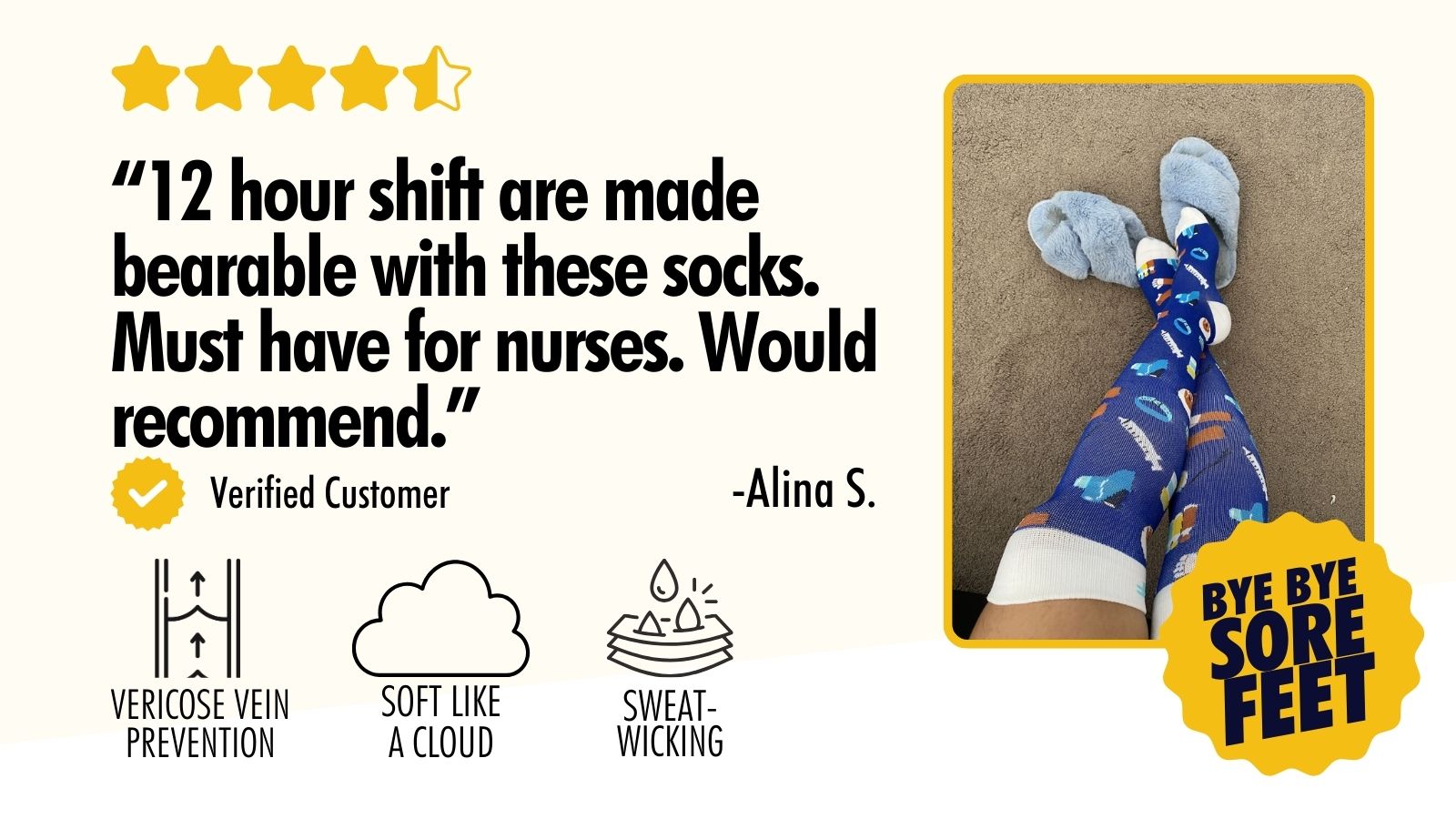
Twelve hours on a vet clinic floor or a hospital ward, and your legs are telling you about it by the drive home. Our compression socks (you’ll also see them called compression stockings) give graduated 15-20 mmHg support, firmest at the ankle and easing off up the calf.
Pick bamboo or Performance knit for long shifts on your feet, long days in a seat, flights, or plain tired legs. Our founders are emergency and critical care vets, and every fabric we use gets tested on a real shift.
Shop Compression Socks by Style
Bamboo Compression Socks
Our bamboo compression socks are the bulk of the range. The rayon-from-bamboo knit wicks sweat, dries fast and stays soft, with no seams running up the leg and extra thickness at the heel and toe against blisters.
Plain colours cover strict uniform policies, and the prints (dogs, cats, sloths, goofy organs) cover everyone else. Shop the full-length pairs as knee-high compression socks.
Crew and Ankle Compression Socks
Our crew compression socks and ankle compression socks come in black, white, navy and grey. The compression stops where the cuff does, so they support your foot and ankle and leave your calf to fend for itself. Reach for knee-highs when your calves are what aches.
Performance Compression Socks
Performance compression socks are built for training as much as shifts. The nylon, polyester and spandex knit is made for high-impact wear, with ventilated zones, ribbed arch support, cushioning at the heel, toe and ankle, and a smooth toe seam that won’t rub.
Same 15-20 mmHg graduated compression, for the gym, a run, or a shift where you barely sit down.
Compression Socks Packs
Curated 4-packs and 6-packs give you a clean pair for every shift of the week. A compression socks pack is the easy way to stock plain pairs for work and a few loud ones for days off.
What 15-20 mmHg Graduated Compression Means
mmHg (millimetres of mercury) measures how firmly a sock squeezes. Graduated means the pressure is highest at the ankle and drops off toward the knee, which helps blood move up your legs instead of pooling around your ankles by hour ten.
15-20 mmHg is moderate compression, the level you can buy without a prescription for tired, achy legs and everyday swelling from standing or sitting. Every pair we make sits at 15-20 mmHg.
Firmer levels, 20-30 mmHg and up, are usually chosen with a doctor. For the mechanics, read how compression socks work and our breakdown of compression sock mmHg levels.
Find Your Fit: Size and Calf Width
Two measurements decide your size: your shoe size and your calf. Pick Small, Medium or Large from your shoe size on the compression socks size chart, then choose Regular, Wide or Extra Wide calf.
Most of the range comes in Wide, and a smaller group in Extra Wide. If compression socks always dig in at the top of your calf, start with our wide calf compression socks.
Measure the widest part of your calf in the morning, before any swelling, and size up if you’re between sizes. Here’s how to measure for compression socks step by step.
On the leg they should feel snug and even, with the cuff resting below the bend of your knee. Rolling or deep marks mean the fit is off (more on how tight compression socks should be). Socks can’t be returned for hygiene reasons, so try one pair before opening the rest of a pack.
Compression Socks for Work, Travel and Every Day
Support socks, compression socks: same 15-20 mmHg squeeze, different places to wear them.
- Long shifts on your feet: compression socks for work for 12 hours on the clinic floor or the ward.
- Flights and road trips: travel compression socks for hours wedged into a seat.
- Pregnancy: compression socks for pregnancy for puffy ankles mid-shift. Check with your midwife or OB first.
- Workouts and recovery: Performance pairs for the gym, runs and hikes.
- Women’s and men’s styles: shop women’s compression socks or men’s compression socks, sized by shoe size and calf either way.
How to Wear Compression Socks
- Put them on first thing in the morning, before your legs have had a chance to swell.
- Use the heel-pocket method: turn the sock inside out down to the heel, slide your foot in until the heel sits in place, then roll the leg up your calf a bit at a time.
- Take them off at bedtime unless a doctor has told you otherwise.
- Wash cool (under 30°C / 86°F) with like colours and hang them to dry. No bleach, no dryer, no iron.
Fighting the first pair on? See how to put compression socks on, when to wear compression socks and whether to sleep in compression socks after nights.
Where to Buy Compression Socks
Pharmacies and medical supply stores carry medical compression socks, usually in beige, black and a couple of sizes. Buy direct from us and you get every size, all three calf widths and the full print range in one place, with the size chart a click away.
Compression Socks FAQ
What do compression socks actually do?
They squeeze hardest at the ankle and less toward the knee, which helps your veins push blood back toward your heart. Your feet, ankles and calves feel less swollen and heavy at the end of a shift.
How many hours a day should you wear compression socks?
At 15-20 mmHg, a full shift or waking day is normal: on in the morning, off before bed. New to compression? Build up from a few hours over the first week. More on how long to wear compression socks each day.
Should I get 15-20 or 20-30 mmHg?
For tired legs, long shifts, travel or everyday swelling with no diagnosis behind it, 15-20 mmHg is the usual starting point, and it’s the level we make. 20-30 mmHg is firmer and meant for diagnosed vein or circulation conditions, on a doctor’s advice.
Are there downsides? Who shouldn’t wear compression socks?
A poor fit can dig in, roll or leave marks. Check with a doctor first if you have peripheral artery disease, open wounds or a skin infection on your legs, or numbness in your feet. Here’s when not to wear compression socks.
Should compression socks feel tight?
Yes. You should feel “the squeeze”: firm and even, like a solid hug. Pain, tingling, numbness or a cuff that bites in means they’re too tight or the wrong size. Give your legs a few wears to adjust.
Knee-high, crew or ankle: which length do I need?
Go knee-high for graduated support all the way up the calf, the usual pick for long shifts and flights. Crew and ankle pairs support your feet and ankles and suit gym shoes or hot weather.








